Located in the Caribbean, Antigua and Barbuda are two small islands that together form a twin microstate of 170 square miles. This island nation also includes Redonda, an extremely small volcanic island formation that remains uninhabited. Antigua is composed of volcanic and sedimentary rock and has a 90-mile jagged coastline with beautiful white sandy beaches. Barbuda, on the other hand, is very flat in terrain. The capital of this island nation, Saint John’s, is in the northwestern part of Antigua.
Antigua and Barbuda’s vibrant and diverse cultural heritage is shaped by its long history of indigenous, European and African influences. The country’s history dates back to 2900BC when a pre-agricultural Amerindian group of people first settled here. Subsequently, a ceramic using group of people from Venezuela migrated to the islands. The nomadic Saladoid group was later replaced by the Arawaks and Caribs between 1200 and 1500AD, and they introduced agriculture to the islands.
European explorers and conquerors took note of these islands, and Christopher Columbus sighted the islands during his second voyage in 1493 and named the larger one “Santa Maria la Antigua” which later became just Antigua. Early European attempts to colonize the islands failed against the Caribs’ defenses. The British eventually took over the islands in 1632. British settlers grew sugarcane there amongst other crops, and this developed into a predominant source of economic income on the islands. Therefore, the traditions of West Africa and the United Kingdom have the biggest impact on the culture of Antigua and Barbuda.
Family Life
The customs and traditions centered around marriage and family life vary amongst the people of Antigua and Barbuda based on their wealth and social class structure. Amongst the more wealthy, upper class, the organization of marriage, family dynamics and gender roles are like those followed in the west with some minor local cultural adaptations. The same generally applies to the middle class, with a marginalized increase in traditional observances and practices. But things are drastically different when it comes to the black working class. There is a large creole influence amongst this segment of the population. The institution of ‘bride wealth’ or a payment made by the bride’s family to the groom and his family, was common in the past and is still practiced today amongst the working class, although less prevalently. The Africans view marriage as the culmination of a process that grows over many years. It starts with what is called visiting relationships. This then commonly transitions to the couple living together, which may finally be formalized into a marriage over a Christian ceremony. Like many African families, these creole families are matriarchal, centering around an ancestral female figure and the mother’s lineage. In recent times, African families have seen strong traditions of women working outside the home. As a result, a lot of the blue-collar labor work is done by Antiguan and Barbudan women.
Language
The culture in Antigua and Barbuda is a bilingual one, with most of the population speaking two languages. It is no surprise that out of the 350 years of continuous British rule, English evolved into the official language of Antigua and Barbuda. Instruction in schools is in English, and all official documentation is also in English. However, Antigua and Barbuda also has its own creole language called Antiguan Creole. It is a distinct local dialect that is spoken by most of the local population. Antiguan Creole is a hybrid of Western African languages and English. African words like ‘nyam’ meaning eat are commonly used in Antiguan Creole along with unique creole formations such as ‘gee’ for give, and a large part of the Antiguan Creole vocabulary also consists of English words. Antiguan Creole tends to be the first language amongst the working class, but there is a gradual shift from Creole to English as the first language as you go higher in the class structure. Spanish is the third language spoken on these islands but by a very small segment of the population.
Dress
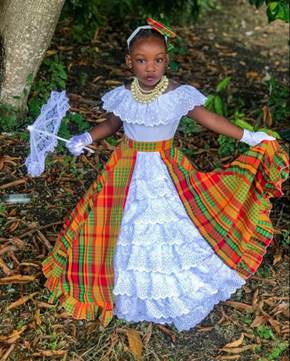
The traditional national dress of Antigua and Barbuda is a colorful outfit consisting of red, which is a symbol for strength, gold and green, both of which appear in the national flag. The dress is made from a type of cotton called Madras fabric and consists of a bright, plaid pattern on a ruffled skirt. This is usually paired with a white bodice and a head piece as in the image below. Traditional dress is usually worn on Independence day in November.
Cuisine
The local cuisine in Antingua and Barbuda has been shaped by African, European and Indigenous influences representing the country’s cultural heritage. The national dish is Fungee and Pepperpot. Fungee is a savory, dough-like item, made from Cornmeal, and Pepperpot is a rich, spicy stew made with okra, spinach, eggplant and meat. The local cuisine has also evolved to include flavors and delicacies from neighboring Caribbean countries. Examples include jerk chicken from Jamaica and roti from Trinidad.
Holidays
Antigua and Barbuda has a long history of multiple festivals and celebrations that highlight the lively native culture and community spirit of the local people.
The Antiguan Carnival, a thirteen-day festival, marked with vibrant parades of people in elaborate, colorful costumes dancing through the streets to calypso and soca music, food fairs, beauty pageants, talent shows and multiple other events, is arguably the most significant cultural event in Antigua. Held annually in late July through to the first Tuesday in August, which is known as Carnival Tuesday, the Carnival commemorates the emancipation of African saves. Both Carnival Monday and Carnival Tuesday are national, public holidays.
Another important holiday is Independence Day. Celebrated annually on November 1st, this national holiday marks Antigua and Barbuda’s independence from Britain in 1981. This day is also celebrated with parades, cultural shows and patriotic events highlighting the country’s history and achievements.
Lastly, the third most decorated holiday celebration is a week-long boat race called Antigua Sailing Week. This takes place in late April and early May and is not only one of the premier sailing events in all of the Caribbean but is one of the top regatta galas in the world, inviting 100 yachts, 1500 competitors, and 5000 spectators every year. This event features opulent parties and cultural activities that celebrate the country’s maritime heritage.
Business Culture
Like all other aspects of Antigua of Barbuda’s life and culture, its business culture is a combination of British formality and a warm, relationship centric Caribbean approach that is built on a foundation of trust and encourages personable, face-to-face meetings and networking. Business on the islands tends to enforce a high respect for hierarchy and professional titles and is almost always conducted in English. Attention needs to be paid to one’s appearance. Although not too formal, conservative lightweight business suits are considered appropriate for meetings. While business is conducted professionally, there is an element of ‘island rhythm’ with respect to time etiquette and decision making, which can be slow, often coming from the senior-level management and then filtering down through the ranks.
References
Original Travel. (2026). “Antigua and Barbuda Culture” Antigua Culture – Original Travel
Anothertravel.com. “Antigua & Barbuda culture, customs and etiquette” Antigua & Barbuda Culture | Customs | Traditions | Etiquette | anothertravel.com
Countries and their Cultures (Copyright 2008) “Antigua and Barbuda”. Culture of Antigua And Barbuda – history, traditions, women, beliefs, food, family, social, marriage, life
Wikipedia. (2025). “Culture of Antigua and Barbuda”. Culture of Antigua and Barbuda – Wikipedia