Located in Eastern Europe, Belarus is a landlocked country bordered by Russia to the east, Ukraine to the south, Poland to the west, and Lithuania and Latvia to the northwest. The country is known for its flat landscape, dense forests, beautiful lakes, and large areas of marshland. Belarus covers approximately 80,000 square miles and populated by about 9 million people. The capital city is called Minsk, and it serves as the political, economic, and cultural center of the country.
The culture of Belarus has been shaped by its location between Eastern and Western Europe. Throughout its history, the region of Belarus was influenced by several neighboring powers including the Polish-Lithuanian Commonwealth, the Russian Empire, and then later the Soviet Union. As a result, Belarusian culture developed through a mixture of Slavic traditions, Orthodox Christianity, and influences from other neighboring countries.
Belarus suffered significant destruction during World War II, losing a large portion of its population and infrastructure. Following the war, the country became one of the republics of the Soviet Union and did not gain its independence till 1991. Although Soviet influence can still be seen in many aspects of daily life, Belarusians have made a significant effort to preserve their own language, traditions, and cultural identity.
Family Life
Family plays an important role in Belarusian society. Close relationships between parents, children, and grandparents are common and extended family members stay well connected.
Traditionally, Belarusian families followed defined gender roles, where men provided for the family financially and women took responsibility for caring for the home and children. However, modern Belarus has seen significant social change. Women are highly educated now and participate in most professional fields, including medicine, education, science, and business.
Marriage is predominantly based on personal choice, and most couples date before getting married. Weddings are important social events that bring together family and friends and often include traditional music, dancing, and large meals.
Language
Belarus has two official languages, Belarusian and Russian. While both languages are spoken throughout the country, Russian is used more frequently in everyday conversations, especially in urban areas.
The Belarusian language is an important part of the country’s cultural heritage and national identity. Efforts have been made to preserve and promote it in schools, literature, music, and cultural programs.
Due to international business and education, English is becoming increasingly popular among younger generations, especially in larger cities such as Minsk.
Dress
In everyday life, Belarusians wear modern western-style clothing like what we wear in the United States. Seasonal weather plays an important role in clothing, with warm coats, boots, hats, and scarves being necessary during the long winter months and loose fitting, comfortable clothing during the summer.
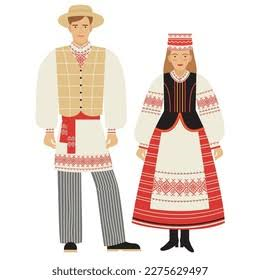
Traditional Belarusian clothing is known for its detailed embroidery and intricate geometric patterns. Women’s traditional wear typically consists of embroidered blouses, long skirts, aprons, and decorative headpieces. Men’s traditional clothing includes embroidered shirts, pants, belts, and boots.
Traditional dress is worn during festivals, cultural celebrations, weddings, and national holidays. The embroidery patterns found on traditional clothing are viewed as an important symbol of Belarusian heritage and craftsmanship. Please see below for an image of Belarusian traditional wear.
Cuisine
Belarusian cuisine reflects the country’s agricultural traditions and cold climate. Meals are warm and hearty and provide energy during the long winters. Potatoes are one of the most important ingredients in Belarusian cooking and are used in many traditional dishes.
One of the most popular national dishes is Draniki, which are potato pancakes that are served with sour cream. Other common foods include sausages, pork, cabbage, mushrooms, and beet soup served with different types of bread. Dairy products such as cheese, butter, and sour cream are also a common part of the Belarusian diet.
Food is an important part of family gatherings. Meals are often prepared from recipes that have been passed down through generations and are shared during holidays and special occasions.
Holidays
Many Belarusian holidays reflect both Christian traditions and national history. Orthodox Christianity is the dominant religion in the country, and religious holidays play an important role in cultural life.
Christmas and Easter are the most important religious holidays. Families generally attend church and then gather for a traditional meal.
One of the most unique festivals in Belarus is Kupalle, also known as Ivan Kupala Night. This summer celebration comes from ancient Slavic traditions and includes bonfires, music, dancing, flower wreaths, and other unique folk customs.
Independence Day is celebrated on July 3rd and commemorates the liberation of Minsk during World War II. The holiday is celebrated with military parades, concerts, fireworks, and patriotic events throughout the country.
Business Culture
Business culture in Belarus places importance on professionalism, respect, and preparation. Meetings are usually formal, and professional titles are valued, particularly during initial introductions.
Organizational structures tend to be more hierarchical than what is commonly seen in the United States, and business decisions are usually made by senior leaders. As a result, decision-making may take time and generally requires approval from multiple levels of management.
Personal relationships are important in establishing trust. While business meetings tend to be formal, developing a good relationship with business partners is appreciated. Professional dress is expected, punctuality is valued, and business communication generally remains direct and focused on facts.
References
Britannica. “Belarus.” https://www.britannica.com/place/Belarus
Countries and their Cultures (Copyright 2008). “Belarus.” https://www.everyculture.com/A-Bo/Belarus.html
Belarus.by. “Traditions of Belarus.” https://www.belarus.by/en/about-belarus/traditions
World Travel Guide. “Belarus Culture.” https://www.worldtravelguide.net/guides/europe/belarus/history-language-culture/
Wikipedia. (2026). “Culture of Belarus.” https://en.wikipedia.org/wiki/Culture_of_Belarus