Burundi is located in East Africa. It is bordered by Rwanda, Tanzania, and the Democratic Republic of Congo. Burundi is situated within the African Great Lakes region and has a beautiful landscape of rolling hills, green farmlands, rivers and lakes. Burundi is actually called the “Land of a Thousand Hills,” a nickname it shares with its neighboring country of Rwanda.
One thing that immediately caught my attention while researching Burundi is how much of the country’s cultural identity is tied to music. Many countries are known for their music and art, but in Burundi, drumming is an integral part of the country’s history. For centuries, royal drummers performed at major ceremonies and important national events. Today, the Royal Drummers of Burundi are recognized around the world and have become one of the country’s most famous cultural symbols. Burundian drummers use large drums, known as karyenda. These instruments carry symbolic importance beyond music. Historical accounts describe the drum as representing power, unity, and national identity. In 2014, UNESCO recognized the Royal Drummers of Burundi and their traditional drumming as an important element of cultural heritage.
Another aspect that surprised me is the country’s unity with language. While many African countries have dozens or even hundreds of languages, a large majority of Burundians speak one language called Kirundi. This creates a strong sense of cultural connection across different regions of the country.
Family Life
Burundi remains a largely rural country, and many people live in small communities where daily life is closely connected to family, friends, neighbors and agriculture. Because villages are tightly knit, people tend to know their neighbors well and community involvement plays an important part of everyday life. Rather than life revolving around the immediate household, community plays a big part of daily activities. People come together for celebrations, construction projects, harvests, and other important events. This collective spirit has been part of rural life and also remains important in many other parts of the country.
Language
Kirundi, the national language of Burundi, is spoken by most of the population. It serves as a unifying force throughout the country and is used in homes, communities, and everyday conversations. French is also an official language and has historically played an important role in government and education. Swahili is commonly spoken in commercial areas and is useful for regional trade within East Africa.
Dress
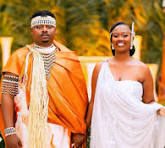
Modern western clothing is common throughout Burundi, especially in cities and larger towns. However, traditional dress can still be seen during weddings, festivals, cultural performances, and other special occasions. Traditional clothing incorporates brightly colored fabrics that reflect East African influences.
For special occasions, women wear an elegant, three-piece outfit known as the imvutano. This outfit requires roughly three meters of lightweight, flowing fabric, such as silk, chiffon, satin, or fine cotton. It closely resembles a sari that is commonly worn in south Asian countries like India. It consists of a floor-length underskirt, paired with a matching stole draped over one shoulder while leaving the other shoulder bare. Men’s traditional clothing for special occasions incudes a long, patterned cloth or white wrapper tied around the waist with a formal robe or drape on top known as a kanzu. See image below.
Cuisine
Many Burundian meals include ingredients grown locally, including beans, sweet potatoes, cassava, maize, bananas, and peas. Beans are important and appear in many everyday dishes. Grilled meats are also popular, and fresh fruits such as mangoes and bananas are widely eaten. Rather than being centered around elaborate recipes, many meals focus on simple ingredients prepared in ways that have been passed down through generations.
Holidays and Celebrations
Independence Day, celebrated on July 1st, commemorates Burundi’s independence from Belgium in 1962. The occasion is marked by ceremonies, cultural performances, and national celebrations. Religious holidays are also commonly observed, as Christianity plays a significant role in the lives of many Burundians.
Business Culture
One thing worth noting about professional interactions in Burundi is the importance placed on personal courtesy. Greetings are considered an important part of establishing a positive interaction and may take longer than what many Americans are used to. Business conversations begin with inquiries about a person’s well-being, family, or community before moving to business matters. These exchanges are generally viewed as a sign of respect rather than wasting time in an official meeting. Decision-making can sometimes be slow when compared to the west.
References
Britannica. “Burundi.” https://www.britannica.com/place/Burundi
Countries and their Cultures (Copyright 2008). “Burundi.” https://www.everyculture.com/A-Bo/Burundi.html
UNESCO. “Ritual Dance of the Royal Drums of Burundi.” https://ich.unesco.org
World Travel Guide. “Burundi History, Language and Culture.” https://www.worldtravelguide.net/guides/africa/burundi/history-language-culture/
Wikipedia. (2026). “Culture of Burundi.” https://en.wikipedia.org/wiki/Culture_of_Burundi