Cambodia is located in Southeast Asia and is bordered by Thailand, Laos, and Vietnam. It has a coastline along the Gulf of Thailand. Most of the country is centered around the Mekong River and Tonlé Sap Lake, which is the largest freshwater lake in Southeast Asia. Cambodia’s capital city is called Phnom Penh. It is situated at the meeting point of several rivers and is the country’s political, economic, and cultural center. Cambodia has experienced periods of great wealth followed by colonial rule that stripped the country of its resources and wealth, leaving it in significant economic hardship. But despite all of this, the country’s cultural traditions have stayed strong, and the people have been resilient. Today, religion, family, food, and ancient customs continue to play an important role in everyday life.
More than ninety percent of Cambodians follow Theravada Buddhism, and Buddhist traditions influence many aspects of daily life. Temples, known as wats, can be found everywhere and serve as community gathering places in addition to religious centers.
Many Cambodian boys traditionally spend some time living as Buddhist monks. This practice is viewed as a way of gaining spiritual knowledge, discipline, and respect for religious traditions. Monks are highly respected in Cambodian society and are always involved in important ceremonies and community events.
Family Life
One thing that stood out to me while learning about Cambodia is the importance of respecting the older generation. Children are taught from an early age to show politeness toward parents, grandparents, teachers, and monks. Decisions within a family are only made after consulting with the older members of the family.
In Cambodia, it is very common for extended families to live together. This creates a built-in support system where multiple generations share responsibility. This is seen in the way kids are brought up in Cambodia. There is no concept of baby-sitting. No one hires baby-sitters from the outside. Grandparents typically take on the responsibility of raising their grandchildren while parents work. Also, older children in the household step up to take care of their younger siblings, making Cambodian family life a collective effort where no one ever has to do anything alone.
Cambodians also place a strong emphasis on getting along and avoiding unnecessary conflict. Maintaining respectful relationships within the family and community is seen as more important than winning an argument.
Language
The official language of Cambodia is Khmer. It is one of the oldest written languages in Southeast Asia and has been used for over a thousand years. Unlike some other neighboring Asian countries, Cambodia has maintained a single dominant national language. French was widely used during the colonial period but is not used to the same extent now. English has become increasingly common among younger generations, particularly in tourism, education, and business, but the dominant language remains Khmer.
Dress
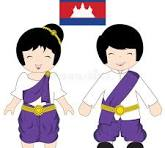
Traditional clothing is an important symbol of national identity in Cambodia. The most recognizable outifit is the sampot, a traditional wrap-around cloth that has been worn in various forms for centuries. The sampot is a single cloth that is about 1 to 3 meters and is worn by both men and women. The styling and pairing with either shirts or blouses varies for men and women. See image below.
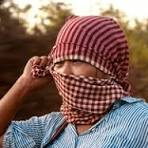
Another item that appears throughout Cambodia is the krama, a checked scarf that is used for everything from sun protection to carrying goods. It is interesting that a single piece of cloth can serve so many purposes. It functions almost like a multi-purpose tool and is one of the most recognizable symbols of Cambodian daily life. Please see an image of the krama.
Cuisine
Rice is the foundation of most meals, and freshwater fish play a major role in the national diet. One traditional dish is Fish Amok. It is Cambodia’s national dish. It consists of fish cooked in rich coconut curry and steamed in banana leaves. Another important ingredient is prahok, a fermented fish paste that has been used in Cambodian cooking for centuries and adds a distinctive flavor to many dishes. Because Cambodia is a tropical country, fruits, and vegetables are widely used in everyday cooking.
Festivals and Celebrations
Cambodia’s most important holiday is the Khmer New Year, celebrated in April. Families gather, visit temples, prepare special meals, and participate in traditional games. Another unique event is the Water Festival, known as Bon Om Touk. What makes this celebration interesting is that it marks the annual reversal of the flow of the Tonlé Sap River, a rare natural phenomenon that occurs because of changes in water levels between the Mekong River and Tonlé Sap Lake. The festival includes colorful boat races, concerts, fireworks, and celebrations that attract participants from across the country.
Business Culture
Business relationships in Cambodia develop gradually. Respect is very important in professional settings. Cambodian business interactions are more indirect and relationship-oriented than the west. Maintaining courtesy and preserving harmony are typically viewed as important parts of successful professional communication.
References
Britannica. “Cambodia.” https://www.britannica.com/place/Cambodia
Countries and their Cultures (Copyright 2008). “Cambodia.” https://www.everyculture.com/Bo-Co/Cambodia.html
UNESCO. “Angkor.” https://whc.unesco.org/en/list/668/
Cambodia Tourism Board. “Culture and Heritage.” https://www.tourismcambodia.org
World Travel Guide. “Cambodia History, Language and Culture.” https://www.worldtravelguide.net/guides/asia/cambodia/history-language-culture/
Wikipedia. (2026). “Culture of Cambodia.” https://en.wikipedia.org/wiki/Culture_of_Cambodia