Located in the southern most part of the continent of South America, the republic of Argentina borders Chile to the west, Bolivia to the north, Brazil, Uruguay, and the Atlantic Ocean to the East. Extending across of 2,229 miles from north to south and encompassing a total area of 1.4 million square miles, Argentina is the eighth largest country in the world. Due to its vast size, Argentina consists of many different climatic zones. Most of the country consists of plains, with temperate climate, ideal for ranching. These plains are a stark contrast to the tropical forests and wetlands to the northeast and to the semi-arid mountain ranges called the Sierras to the northwest. The culture of Argentina is as diverse as the country’s geographical landscape, but modern Argentine culture is predominantly influenced by Spanish colonial rule and an influx of European immigrants during the nineteenth and twentieth centuries.
Like many other parts of South America, Argentina was originally inhabited by indigenous populations. The Spanish first took control of the arid northwestern territory of Argentina in 1516. Several decades later, in 1580, Juan de Garay, a Spanish conquistador, established a colony, the ‘City of Trinidad’, on the banks of River Plate, which eventually became Buenos Aires, meaning ‘fair winds’. Buenos Aires is the capital of Argentina and has developed into the center of the national culture of Argentina.
Argentina has a population of approximately 43 million people. Most people in Argentina are of European descent, particularly Spanish and Italian. This is a differentiator for Argentina, when compared to other Latin American countries where European and local traditional cultures are more integrated. There is only a very small portion of the Argentinian population that are descendants of one of the many indigenous groups that inhabited the country prior to European rule. So, culturally, Argentinians are more like Europeans than Latin Americans.
Family Life
The family is the center of Argentine culture and is considered the most important part of life. Individuals generally remain very loyal and committed to their families, often prioritizing the needs and interests of their family above their own. The family network in Argentina is considered to serve as a foundational support system. Parents generally make sacrifices to be able to provide for their children and in turn, children usually take care of their parents in their old age. The nuclear family, with a married couple and their children, living in one household is common, but Argentines generally maintain close relationships with their extended families. The average Argentine nuclear family tends to be larger, especially among the lower class. Large families can get government financial assistance to help support their children. It is customary for Argentine boys and girls to live at home until they graduate college or get married. Extended families meet and visit one another frequently and celebrate life occasions together.
Gender roles in Argentina are similar to those traditionally observed in the west. In Latin America, ‘machismo’ and ‘marianismo’ refer to the characteristics commonly identified with men and women respectively. Like in most other places, Argentine culture traditionally expects men to be masculine, dominant and independent, while women are expected to be soft, caring and nurturing. In line with this, household duties and caring for children is a responsibility that traditionally lies with the mother, whereas the father is responsible for financially supporting the family. This is now changing in modern day Argentina. Men take on more household duties, and many women work outside the home. In addition, communities are becoming more accepting of the variations to the traditional family such as unmarried couples, couples who choose not to have children, single mothers, and LGBTQ couples.
Dating in Argentina generally starts at the age of 15, after girls have a very important birthday celebration called ‘cumpleanos de quince’, which marks the transition from childhood to adulthood. Serious relationships generally take time, over many years, before a couple decides to get married, but couples that decide to only live together without getting married are also becoming more common.
Language
There are at least 40 languages spoken in Argentina, but Spanish is predominantly used everywhere and is spoken by most Argentines. The most common dialect of Spanish in Argentina is called Rioplatense, also known as “Argentine Spanish”. An interesting point regarding Argentine Spanish is that it is one of the few Spanish dialects, worldwide, that almost exclusively uses a formal version of the pronoun you, called ‘vos’, instead of the informal version tu.
Some of the other languages spoken in Argentina include Italian, German, French and English. Some indigenous tribal languages are also still present today, especially amongst the older generations, and these languages include Quechua, Mapuche, Guarani, Toba and Tehuelche.
Dress
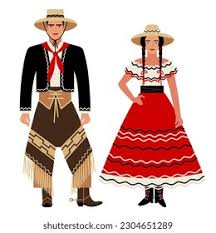
The traditional dress in Argentina is a functional, rustic type wear that is suitable for rural life on the plains and horseback riding. Traditional clothing for men is like that of western cowboys. It consists of ‘bombachas’, which is a wide, baggy pair of pants that end at the ankle, practically designed for comfort while horseback riding. There is usually a piece of cloth that is passed between the legs and then fastened at the waist with a belt over the bombachas, called the ‘chiripa’. This is intended to be a flexible garment that is also protective while on horseback. Men also traditionally wear a poncho, a thick woolen cover with an opening for the head, that is intended for protection against the cold. Ponchos are usually woven in vibrant patterns and colors. Men also wear leather boots, a wide leather belt, a neck scarf, and a wide brimmed hat, all intended for protection against the weather and designed for functionality with horse riding. Women, on the other hand, traditionally wear long dresses or flowy skirts with blouses, a shawl for warmth and hat for protection against the sun. Women’s wear is usually decorated and embellished with vibrant, floral prints. Please see image below.
Cuisine
Argentines love their meat, and it is heavily incorporated into the cuisine. In fact, Argentina has the highest consumption of red meat in the world. Beef is a staple meat used in many Argentinian dishes. Popular dishes include empanadas stuffed with beef, chicken and cheese, chorizo, which is a pork sausage, steak and ribs, all usually cooked slowly on an iron grill barbecue. These dishes are served with a strong, flavorful sauce called chimichurri.
Tap water is safe to drink throughout Argentina, but bottled water is also available everywhere in the country. Wine is also very popular in Argentina. The wine industry in Argentina is the largest in the world outside of Europe. Argentina is the fifth largest wine producer in the world. The Malbec grape grows well in the Province of Mendoza, where 70% of the country’s wine production comes from. A caffeinated herbal drink made from dried leaves and stems of a plant called yerba mate is the national drink. The yerba mate is ground into a powder which is mixed with hot water, almost like coffee.
Holidays
The main holidays and festivals in Argentina either have to do with the national identify and pride in the country or religion. General Belgrano Memorial Day, also known as Flag Day, is a national holiday to commemorate the creation of Argentina’s national flag. It is celebrated on June 20th with the raising of the flag, parades and other civic ceremonies. The Argentinian Independence Day on June 9th celebrates the country’s independence from Spanish rule with a lot of public parades, music, dance, and gatherings with traditional foods and fireworks. The other big holiday is Christmas. The predominant religion in Argentina is Christianity because of the Spanish rule and European immigration. So, Christmas is celebrated with religious observances followed by family and friends’ gatherings.
Business Culture
Personal relationships and networking play a crucial part of Argentinian business culture. It is important to take the time to engage in initial meetings to get to know the individual or individuals that you are trying to have a business relationship with. Following Latin American practice, it is not unusual for initial meetings to be less formal and be held at a bar or a restaurant. It is believed that these social settings help with rapport building. Since family is extremely important to Argentinians, the rapport often includes conversations about families and personal lives. However, once official undertaking of a business agreement, things are handled more formally and all commitments that were made in a social environment are then expected to be translated into legal contractual documents. Punctuality for business meetings is important. Professional titles and education level is well regarded in Argentina. So, if meeting with a doctor for business, addressing him or her by their title is considered critical. Lastly, engaging in a business conversation is essential. Meeting participants are often seen interrupting each other and talking a lot. This is not considered rude but instead, a way of showing enthusiasm and keen business spirit.
References
Original Travel. (2026). “Argentina Culture” Argentina Culture: Language, Religion, Food – Original Travel
Cultural Atlas. (2026). “Argentine Culture” Argentina — Cultural Atlas
Countries and their Cultures (Copyright 2008) “Argentina”. Culture of Argentina – history, people, traditions, women, beliefs, food, customs, family, social
Wikipedia. (2025). “Culture of Argentina”. Culture of Argentina – Wikipedia