Located at the intersection of Eastern Europe and Western Asia, the Republic of Azerbaijan lies along the western shore of the Caspian Sea. Azerbaijan shares a border with Russia to the north, Georgia to the northwest, Armenia to the west, and Iran to the south. The country also includes the autonomous region of Nakhchivan, which is geographically separated from the rest of Azerbaijan by Armenian territory. Although not a large country in terms of land area, Azerbaijan occupies a strategically important location between Europe, Central Asia, and the Middle East, making it an important region for trade, migration, and cultural exchange for thousands of years.
Azerbaijan is often referred to as the “Land of Fire.” This name comes from the natural gas deposits that have been burning continuously from the earth’s surface for centuries. Historically, the region was influenced by many civilizations and empires, including the Persians, Arabs, Turks, Mongols, and Russians. As a result, Azerbaijani culture developed as a blend of Turkish, Persian, and Islamic traditions. The people of Azerbaijan maintained their own identity despite centuries of foreign rule and continue to take great pride in their cultural traditions.
During the nineteenth century, Azerbaijan became part of the Russian Empire and later the Soviet Union. Soviet rule brought significant changes to education, language policies, and daily life. When the Soviet Union collapsed in 1991, Azerbaijan gained independence and began rebuilding its national identity. Although modern Azerbaijan is undergoing economic development and globalization, many traditional customs remain deeply ingrained into everyday life and continue to shape the culture of the country.
Family Life
Family is considered the foundation of Azerbaijani society. The culture tends to be collective rather than individualistic, and loyalty to family is very important. Extended family relationships are valued, and it is common for relatives to remain actively involved in each other’s lives. Respect for elders is a strong cultural value. Older family members are viewed as sources of wisdom and are generally consulted when important decisions need to be made.
Traditionally, Azerbaijani society was patriarchal, with men serving as the heads of households and primary providers for the family. Women generally carried the responsibility for raising children and managing the home. However, modern-day Azerbaijan has experienced significant social change, particularly in urban cities such as Baku. Women now participate in higher education and have professional careers, but traditional expectations regarding family and gender roles still influence many households.
Marriage is considered an important part of family life. Historically, families played a significant role in selecting marriage partners and arranging introductions between couples. While modern marriages are based on personal choice, family approval is still considered very important. Azerbaijani weddings are known for being large celebrations that bring together extended family members, friends, and members of the wider community. Wedding festivities often include elaborate meals, traditional music, dancing, and cultural traditions that have been passed down through generations.
Language
The official language of Azerbaijan is Azerbaijani, also known as Azeri. Azerbaijani shares many similarities with Turkish. The language serves as one of the strongest symbols of Azerbaijani national identity and is spoken by most of the population.
Due to the country’s history as part of the Soviet Union, Russian is also widely understood, particularly among older generations and in larger cities. English is becoming more common among younger Azerbaijanis, especially those involved in higher education, international business, and tourism. As a result, many people in Azerbaijan are multilingual.
Dress
In daily life, Azerbaijanis generally wear modern western-style clothing like what is worn in the United Sates. However, traditional clothing remains an important symbol of Azerbaijani culture.
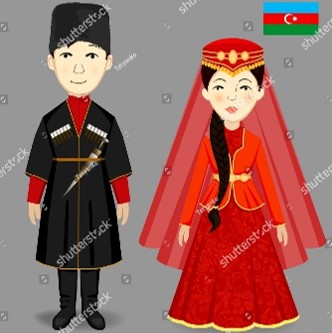
Traditional Azerbaijani clothing varies by region but generally includes long flowing garments, decorative head coverings, embroidered jackets, and ornate jewelry for women. Men’s traditional clothing includes long coats called chokhas, wide belts, leather boots, and hats. See image below of traditional wear for both men and women. Many traditional garments were designed to be practical for village life and the varied climate found throughout the country. Today, traditional attire is worn during cultural festivals, weddings, folk dance performances, and national celebrations.
Cuisine
Azerbaijani cuisine reflects the country’s location between Europe and Asia. Influences from Persian, Turkish, and Middle Eastern cooking traditions can all be seen in local dishes. Food plays an important role in family life, celebrations, and hospitality, and guests are welcomed with lots of food and drinks.
One of the most famous dishes in Azerbaijan is Plov, a rice dish typically prepared with meat, vegetables, herbs, nuts, and dried fruits. Plov is often served during holidays, weddings, and special family gatherings. Other popular dishes include Dolma, consisting of vegetables or grape leaves stuffed with meat and rice, Kebabs, and Kufta, which are seasoned meatballs served with sauce.
Tea is important in Azerbaijani culture and is considered an important symbol of hospitality. Guests are commonly greeted with tea served in traditional pear-shaped glasses. Tea is shared over conversation and social connection and is a common feature of daily life.
Holidays
One of the most important holidays in Azerbaijan is Novruz, celebrated each year around March 21st. Novruz marks the arrival of spring and the beginning of the new year. Families prepare special foods, clean their homes, visit relatives, and participate in community celebrations. Colorful festivities, music, dancing, and traditional customs make Novruz one of the most celebrated holidays of the year.
As a predominantly Muslim country, Azerbaijan also observes important Islamic holidays such as Ramadan and Gurban Bayram, commonly known as Eid al-Adha. These holidays focus on prayer, family gatherings, sharing food with relatives and neighbors, and charitable work.
Azerbaijani Independence Day on May 28th commemorates the country’s independence and provides an opportunity for citizens to celebrate their national identity, history, and culture.
Business Culture
Azerbaijani people generally prefer to do business with individuals they know and trust. As a result, building relationships is often viewed as an essential part of successful business dealings.
Hierarchy plays an important role within many Azerbaijani organizations. Decisions are made by senior leaders and managers, and professional titles are respected.
Professional dress is expected in business environments, and punctuality is valued, although business discussions may take longer than what many western professionals are used to. Azerbaijanis generally prefer face-to-face communication when developing business relationships. Once trust has been established, business partnerships are usually considered a long-term commitment.
Wikipedia. (2026). “Culture of Azerbaijan”. Culture of Azerbaijan – Wikipedia
Countries and their Cultures (Copyright 2008) “Azerbaijan.” Culture of Azerbaijan – history, people, traditions, women, beliefs, food, customs, family, social
Shania Travel. “The Culture of Azerbaijan.” The culture of Azerbaijan – travel to Uzbekistan, Central Asia and the Caucasus
World Atlas. (2026). “The Culture of Azerbaijan.” The Culture Of Azerbaijan