Located in West Africa along the Gulf of Guinea, Benin is bordered by Togo to the west, Nigeria to the east, and Burkina Faso and Niger to the north. Although Benin is a relatively small country, it has played an important role in West African history for centuries. The country’s largest city is Cotonou, which serves as the economic center, while Porto-Novo is the official capital.
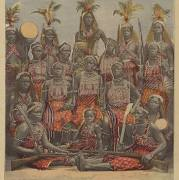
Benin was once home to the powerful Kingdom of Dahomey, one of the most influential kingdoms in West Africa from the 1600s through the late 1800s. The kingdom became known for its strong military and sophisticated government. One of the most interesting parts of Dahomey’s history was its elite unit of female warriors, often referred to as Mino by the natives and the Dahomey Amazons by the Europeans. These women served as trained soldiers and were highly respected throughout the kingdom. See an illustration of this warrior group below.
Later, Benin came under French colonial rule and became known as French Dahomey. After gaining independence from France in 1960, the country adopted the name Benin. Today, elements of both its African heritage and French influence can be seen throughout everyday life.
Family Life
Life in Benin is often centered around both family and community. It is common for relatives to remain closely connected, even if they do not live in the same household. Respect for elders is considered important. Older family members are viewed as the keepers of family history and traditions, and younger generations are expected to treat them with respect. In rural areas especially, communities tend to be very interconnected, and major life events such as weddings, births, and funerals often involve large gatherings that bring together entire villages or neighborhoods.
In Benin, women traditionally hold the primary decision-making power regarding household budgets, and childcare within the family. Men have traditionally taken a more authoritative role in matters outside the home. Another interesting traditional practice is what widows are supposed to do after their husband dies. During the traditional mourning period, a widow usually sleeps on leaves on the floor, uses a special small broom held in her right hand, eats with her left hand, and stirs her warming fire using only her foot. They wear white or black and refrain from going out of the home during the mourning period.
Language
French is the official language of Benin and is used in government, schools, and business. This is a product of the country’s time as a French colony. However, many local languages are used in daily, everyday life. More than fifty languages are spoken throughout the country, with Fon, Yoruba, Bariba, and Dendi among the most common. Someone may speak one language at home, another when out socializing, and French at school or work. This multilingual environment is one of the things that makes Benin very culturally unique.
Dress
Modern western-style clothing is common throughout Benin, particularly in larger cities. At the same time, traditional clothing remains an important part of cultural life and is regularly worn for celebrations, religious ceremonies, and important family events.
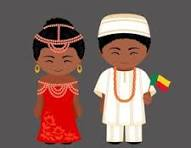
Many traditional garments are made from brightly colored fabrics with bold geometric patterns. Women often wear flowing dresses paired with matching head wraps, while men wear long tunics or robes. See below image for a representation of traditional cultural clothing for men and women in Benin.
Cuisine
The food eaten in Benin is heavily influenced by locally grown crops such as corn, cassava, yams, and beans. Because the country has a coastline along the Gulf of Guinea, fish is also a common part of many meals.
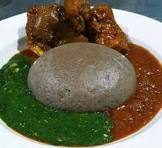
One traditional food found throughout Benin is pâte, a smooth dough-like staple usually made from corn flour or cassava flour. It is commonly served with soups, vegetable sauces, or stewed meats. See below image of a plate of pâte.
Another interesting feature of Beninese cuisine is the popularity of open-air food markets. In cities and towns, vendors sell everything from grilled fish and spicy meats to tropical fruits and fried snacks, making street food an important part of everyday life. Markets also offer a meeting place for families to gather over their daily routines and are filled with a blend of rich aromatic smells of spices, meats and vegetables.
Holidays
One of the most unique celebrations in Benin is National Vodun Day, which takes place each year on January 10th. Benin is widely considered the birthplace of Vodun, a traditional West African religion that influenced Voodoo traditions in Haiti and other parts of the Americas. During the festival, participants gather for music, dancing, ceremonial rituals, and cultural performances. It is one of the country’s most distinctive cultural events and attracts visitors from around the world. Benin also celebrates Independence Day on August 1st, which commemorates independence from France in 1960.
Business Culture
Personal connections play an important role in business in Benin, as they do in most countries. People generally prefer to get to know one another before discussing major business matters, which means business conversations may begin with discussions about family, health, or community.
French is the language used in formal business settings. Organizational structure is based on hierarchy. Senior leaders are usually responsible for making major decisions, and patience is often important during negotiations. Formal contracts may not be used in Benin as commonly as in the West. So, verbal agreements are considered just as binding in some cases as written ones.
References
Britannica. “Benin.” https://www.britannica.com/place/Benin
Countries and their Cultures (Copyright 2008). “Benin.” https://www.everyculture.com/A-Bo/Benin.html
African Studies Centre Leiden. “Benin.” https://www.ascleiden.nl
World Travel Guide. “Benin History, Language and Culture.” https://www.worldtravelguide.net
Wikipedia. (2026). “Culture of Benin.” https://en.wikipedia.org/wiki/Culture_of_Benin