Nestled high in the eastern Himalayas between India and China, Bhutan is one of the most unique countries in the world. Towering mountain ranges, deep valleys, flowing rivers, and lush forests cover a lot of the landscape. Because of its rugged geography, many villages remained isolated from one another for centuries, helping preserve unique local traditions and ways of life. The capital city, Thimphu, is located in a mountain valley and is very different to most modern capitals. One of the first things visitors often notice is that there are no traffic lights in the city. Instead, traffic is directed by police officers standing in small decorative booths at most street intersections.
For most of its history, Bhutan deliberately limited outside influence in order to protect its culture and independence. As a result, many traditions that have disappeared in other parts of world still remain a visible part of everyday life in Bhutan. Buddhism shapes a lot of Bhutanese society, influencing everything from architecture and festivals to how people view their relationship with each other and with nature.
One of the most famous aspects of Bhutan is its concept of Gross National Happiness (GNH). Rather than measuring national success through economic growth like most other countries, Bhutan promotes the idea that the well-being of its people, preservation of culture, and the protection of the environment are equally important. This philosophy has attracted international attention and has become closely associated with Bhutan. There is a lot more importance placed on the people and communities of Bhutan rather than national statistics.
As one of the many metrics of GNH scoring, Bhutan literally tracks whether its citizens get enough sleep as an official measure of national progress. The government sets an official guideline for “sleep sufficiency” at 8 hours of sleep per day, and during periodic nationwide census surveys, citizens count their 24-hour activities down to the minute to evaluate whether they are sleeping enough. Changes in the national sleep averages directly move Bhutan’s official GNH score up or down. The GNH is considered to be just as important and sometimes more important than other traditional national economic statistics like the GDP.
Family Life
Life in Bhutan has traditionally revolved around both family and community. In many rural areas, neighbors still work together during planting and harvest seasons, and important events often involve the participation of the entire village.
One aspect of Bhutanese society that is very unique is the strong role women have historically played within the family. In some regions, inheritance is passed down through daughters rather than sons. Agricultural land, the family home, and household assets traditionally pass down from a mother to her daughter. Women officially own about half of the country’s land, a number that climbs up to 60% in rural areas. Because the women own the property, marriage traditions are completely inverted compared to conventional historical norms. After marriage, the husband leaves his household and relocates to the wife’s home. Also, when a woman marries, she does not change her last name to match her husband’s. In addition, children in Bhutan do not traditionally carry a family surname passed down from the father.
Language
The official language of Bhutan is Dzongkha. The word “Dzongkha” literally translates to the language of the fortresses, reflecting its historical roots of being spoken inside Bhutan’s massive ancient mountain structures. Dzongkha is taught in schools and used by the government for all official communication, but Bhutan is a lot more linguistically diverse than many people realize. Because villages were separated by mountains for centuries, numerous languages and dialects developed throughout the country. In some remote regions, communities speak languages that are completely different from Dzongkha.
This mix of local languages reflects Bhutan’s geography. Mountains that once made travel difficult also helped preserve distinct cultural identities from one valley to the next. English is also widely taught in schools and is commonly used in education and government today, making many people in Bhutan fluent in multiple languages.
Dress
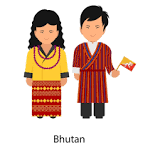
Unlike many countries where traditional clothing is reserved for festivals and museums, Bhutanese traditional dress is worn every day. Men wear a knee-length robe called a Gho, while women wear an ankle-length garment known as a Kira. Professionals and students wear traditional clothing as part of daily life as opposed to western wear. Traveling through Bhutan, it is common to see people dressed in traditional attire while heading to work and attending school. This practice is part of Bhutan’s broader effort to preserve its cultural heritage in a rapidly changing world. Please see an image of the cultural clothing of Bhutan.
Cuisine
Bhutanese food is shaped by the country’s mountainous environment and cooler temperatures. Meals tend to be simple, filling, and pretty spicy. The national dish is Ema Datshi, a combination of chili peppers and cheese that is served with rice. What makes this dish unusual is that the chilies are not used as a seasoning. They are the main ingredient. Bhutanese cuisine uses chili peppers so extensively that many people jokingly say they are vegetables rather than spices. Rice is the staple food throughout the country, often served alongside vegetables, dried meats, and cheeses made from yak or cow milk. Butter tea, a drink made with tea leaves, butter, and salt, is also popular in many mountain communities.
Festivals and Traditions
If there is one thing that best captures the spirit of Bhutanese culture, it is the country’s festivals. Throughout the year, Bhutanese communities gather for celebrations known as Tshechus. These festivals are held at monasteries and fortresses called dzongs and feature colorful masks, elaborate costumes, music, and sacred dances that tell stories from Buddhist traditions. People travel long distances to attend. Some families spend months preparing special clothing and jewelry for the occasion.
Prayer flags are another common thing throughout Bhutan. They are placed on hillsides, mountain passes, and bridges. Rather than serving as decorations, they are believed to carry prayers and blessings through the wind.
Business Culture
Business in Bhutan tends to move at a slower pace than in many western countries. Aggressive negotiation styles that might be common in other parts of the world are not regarded favorably in Bhutan. Humility, patience, and mutual respect are highly valued. As Bhutan continues to modernize, international business practices have become more common, specifically in the capital city of Thimphu. However, many traditional values remain the same, and understanding local customs is an important part of establishing successful professional relationships.
References
Britannica. “Bhutan.” https://www.britannica.com/place/Bhutan
Bhutan Travel. “Culture of Bhutan.” https://www.bhutan.travel
Smithsonian Magazine. “Bhutan’s Gross National Happiness.” https://www.smithsonianmag.com
Royal Government of Bhutan. “About Bhutan.” https://www.gov.bt
World Atlas. “Culture of Bhutan.” https://www.worldatlas.com
Wikipedia. “Culture of Bhutan.” https://en.wikipedia.org/wiki/Culture_of_Bhutan