Bosnia and Herzegovina is in the southeastern part Europe on the Balkan Peninsula. It shares borders with Croatia, Serbia, and Montenegro. The country is known for its beautiful mountainous landscape, vast network of rivers, and historic towns. The country has a small stretch of coastline along the Adriatic Sea, but most of its terrain consists of rugged hills and valleys. The capital city is Sarajevo.
Bosnia and Herzegovina holds a unique place in Europe both territorially and historically as it has functioned as the crossroads of different civilizations for a very long time. The history of this region was influenced by the Roman Empire, the Byzantine Empire, the Ottoman Empire, and later the Austro-Hungarian Empire. Each left its mark on the country’s architecture, cuisine, traditions, and religious practices.
One of the most interesting parts of Bosnia and Herzegovina is the way different faiths have shaped the country. Mosques, Catholic churches, Orthodox churches, and synagogues are often found in the same vicinity. This blending of influences is especially visible in Sarajevo. This capital city is one of the few places in the world where you can stand in a single spot and see a mosque, a Catholic church, an Eastern Orthodox church, and a synagogue all within a short 5-minute walk of each other. This is the reason why Sarajevo got its nickname, “Jerusalem of Europe.”
Family Life
Family is very important in Bosnia and Herzegovina. Relatives maintain close connections, and family gatherings are common during holidays, and celebrations. Hospitality with family, friends and other guests is highly valued. Guests are welcomed warmly and are usually offered coffee, sweets, or a meal. Visiting friends and relatives is an important social activity, particularly in smaller towns and villages and is sometimes done spontaneously with no notice.
Traditionally, Bosnian families followed a patriarchal structure where men were considered the formal heads of households, but women also had a lot of authority and decision-making power inside the home. In fact, during the 1992–1995 Bosnian War, women were primarily responsible for family survival, maintaining households, hiding and feeding children, and crossing front lines to get basic necessities while men were fighting in the war.
Language
The country has three official languages: Bosnian, Croatian, and Serbian. These three languages are very similar and are typically understood by speakers of each of the languages. But despite the similarities, each of the three languages remain a distinct and important part of the cultural and national identity of different communities within the country.
English is commonly spoken among younger generations, especially in larger cities and within the tourism industry. German is also common due to historical ties and immigration patterns between Bosnia and several German-speaking countries.
Dress
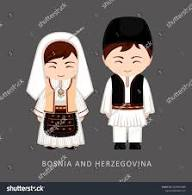
Most people in Bosnia and Herzegovina wear modern western-style clothing, but traditional clothing holds a special place in the country’s culture and heritage. Traditional clothing, however, does vary by region and reflects the country’s diverse cultural influences. In rural areas, traditional outfits generally feature embroidered vests, colorful aprons, decorative belts, and handcrafted jewelry. Many traditional designs reflect both Ottoman, Austrian and Hungarian influences, giving the Bosnian cultural dress a distinctive appearance compared to neighboring countries. See below for an image of Bosnian traditional clothes.
Cuisine
Bosnian food has been heavily influenced by the country’s history. Centuries of Ottoman rule introduced dishes that remain popular even today, while Central European influences can also be seen throughout the country. One of the most famous dishes is ćevapi, small grilled sausages served inside a flatbread called somun with onions. Another popular meal is burek, a flaky pastry filled with meat, although cheese, potato, and spinach versions are also pretty common too.
Coffee holds a special place in Bosnian culture. Traditional Bosnian coffee is prepared in a small copper pot called a džezva and is enjoyed slowly while socializing with family or friends. Bosnian coffee is famous for a unique serving ritual where the entire pot, džezva, is brought directly to your table rather than being poured in the kitchen. See image below. For many people, sharing coffee is as much a social activity as it is a daily drink.

Festivals and Traditions
The country’s traditions reflect its blend of religious and cultural influences. Islamic, Orthodox Christian, Catholic, and Jewish holidays are all observed by different communities across the country.
One of the most recognizable landmarks in Bosnia and Herzegovina is the Old Bridge, known as Stari Most, in the city of Mostar. Each summer, local divers leap78 feet from the bridge into the Neretva River below, continuing a tradition that dates back centuries to prove bravery and as a historic rite of passage into manhood.
Music also plays an important role in Bosnian culture. A traditional musical style known as Sevdalinka is often referred to as the soul of Bosnian music. These songs typically tell stories about love, longing, and everyday life.
Business Culture
Business interactions in Bosnia and Herzegovina tend to combine professionalism with a strong emphasis on personal relationships. Initial meetings often include informal conversation before moving into business matters. Taking time to establish rapport is appreciated and can help build trust over the long term.
Professional titles are respected, and organizational structures can be pretty hierarchical. However, personal connections and reputation plays an important role in successful business relationships. Punctuality is valued, although meetings can be less rigidly structured than in some northern European countries. So, business decisions and dealings in Bosnia typically may take a lot longer than what would be considered typical in the West.
References
Britannica. Bosnia and Herzegovina.
Countries and their Cultures (Copyright 2008). Bosnia and Herzegovina.
Encyclopedia of the Nations. Bosnia and Herzegovina Culture.
World Travel Guide. Bosnia and Herzegovina History, Language and Culture.
UNESCO. Old Bridge Area of the Old City of Mostar.
Wikipedia (2026). Culture of Bosnia and Herzegovina.