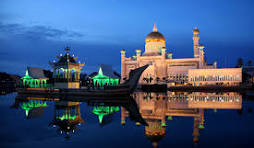
Brunei is one of the smallest countries in Asia, but it has a very remarkable and distinct identity. It is bordered almost entirely by the Malaysian state of Sarawak. Brunei is known for its rainforests, beautiful mosques, and a deep connection to Islamic traditions. The capital city of Brunei is Bandar Seri Begawan. It is home to one of the most recognizable landmarks in Southeast Asia, the Sultan Omar Ali Saifuddien Mosque. See image below of the mosque.
Brunei’s culture is built upon a national philosophy known as Malay Islamic Monarchy, which combines Malay traditions, Islamic values, and loyalty to the ruling sultan. This philosophy influences many aspects of daily life and public culture. This philosophy was formally put into practice when Brunei got its independence in 1984. The philosophy shapes the country’s laws and identity through the below three distinct pillars.
- Malay Culture: This pillar preserves traditional Malay customs, heritage, and social hierarchies and preserves Malay as the official language.
- Islam: Islam is the official religion. It guides public morals, and national values, and daily practices.
- Beraja or the monarchy: The Sultan is considered the head of government and has absolute power, and citizens are expected to hold deep respect and loyalty to the sultan.
Family and daily Life
Family occupies a central place in Bruneian society. Family life in Brunei is quiet, safe, and deeply rooted in Islamic traditions and strong extended family bonds. Social life centers around home gatherings, local cafes, and family outings and usually don’t involve any loud parties or night life. There are no bars or public clubs because alcohol is prohibited in the Islamic religion and culture. This makes Brunei a very calm place to raise a family. Citizens are well taken care of with no personal income tax, free healthcare and education.
One of the most unusual ways of living and cultural features of Brunei is Kampong Ayer, sometimes called the “Water Village.” This is located in the heart of Brunei’s capital and is the world’s largest and oldest floating village. People have lived in these water village communities built on stilts above the Brunei River for hundreds of years. Houses, schools, mosques, and shops are connected by wooden walkways.
Language
The official language of Brunei is the standard Malay that is spoken in Malaysia. Standard Malay is used for government work, legal courts, and education. But the spoken language in Brunei is Brunei Malay and sounds different from standard Malay. English is widely used in business and in other professional areas. Mandarin is also spoken within parts of the Chinese community. Arabic is used for Islamic prayers and taught in religious schools
Cuisine
Brunei’s food is a spicy, halal blend of Malay, Chinese, and Indian influences. Brunei is famous for ambuyat, a sticky starch made from the sago palm. This is the country’s national dish. You twirl it with a bamboo fork called a chandas and swallow it without chewing after dipping it in a sour, spicy fruit sauce called cacah.
Rice, seafood, noodles, and curries are also widely enjoyed, reflecting both Malay and broader Southeast Asian influences.
Business Culture
Business interactions in Brunei are generally polite and measured. Professional relationships often develop gradually, and courtesy is highly valued.
Hierarchy and formal titles carry importance, particularly during introductions. Patience and respect tend to leave a stronger impression than aggressive negotiation tactics.
References
Britannica. “Brunei.” https://www.britannica.com/place/Brunei
Brunei Tourism. “Culture and Heritage.” https://www.bruneitourism.com
Wikipedia. (2026). “Culture of Brunei.” https://en.wikipedia.org/wiki/Culture_of_Brunei
WorldAtlas. “Culture of Brunei.” https://www.worldatlas.com/articles/culture-of-brunei.html