Bulgaria is located in southeastern Europe along the Balkan Peninsula. It is situated at the crossroads of Europe, Asia, and the Middle East. It is bordered by Romania, Serbia, North Macedonia, Greece, and Tukey. While Bulgaria is not one of Europe’s larger countries, it has a very long history. In fact, Bulgaria is one of the oldest countries in Europe that has kept its name since it was founded in 681 AD.
It is interesting to note how Bulgaria holds on to its traditions. Many countries preserve their cultural customs in museums or history books. But, in Bulgaria, traditions are commonly practiced as part of everyday life. Ancient rituals, traditional music, regional festivals, and family customs are celebrated throughout the country just as they have been for centuries.
Bulgarians are really proud of their history, particularly in their role of preserving the Slavic culture and developing the Cyrillic alphabet, which is now used by hundreds of millions of people across Eastern Europe and parts of Asia. When Bulgaria joined the European Union in 2007, the Cyrillic alphabet officially became the third European script, along with Latin and Greek.
Family Life
Family is the center of Bulgarian society. With modern lifestyles, many people move away for education and/or work, but close ties are maintained with family regardless of distance. Something interesting about Bulgarian households is that the entire family participates in a massive annual ritual every summer to make homemade winter provisions—such as roasting red peppers, making pickled vegetables, and cooking a traditional pepper-and-tomato spread called lyutenitsa together in large outdoor cauldrons. Another thing that stands out in Bulgarian culture is the importance of hospitality. Guests are often welcomed warmly and quickly offered coffee, homemade pastries, fruit, or a meal. Refusing hospitality can sometimes be viewed as rude because generosity is considered an important cultural value.
Language
The official language of Bulgaria is Bulgarian, the first Slavic language to be written down, using the Cyrillic alphabet. Bulgaria takes a lot of pride in its connection to the Cyrillic alphabet. Several countries use this alphabet today, but its development is due to medieval Bulgarian scholars and religious centers. For many Bulgarians, the alphabet is not just a writing system but an important part of their cultural heritage.
A famous and quirky cultural feature of Bulgarian communication in Bulgaria is that nodding your head up and down means “no,” while shaking your head side-to-side means “yes.” This is the exact opposite of what we are used to in the United States
Traditions
The main thing that makes Bulgarian culture unique is the way ancient traditions are maintained. Every year on March 1st, people exchange small red-and-white decorations called Martenitsi. Friends and family wear them as symbols of health, happiness, and the arrival of spring. The tradition is so big that entire cities become decorated with red and white during this time of year. Another fascinating tradition involves the Kukeri. During winter festivals, men dress in elaborate costumes covered with animal skins, huge bells, and somewhat scary masks. The costumes are intended to scare away evil spirits and bring good fortune for the coming year.
Dress
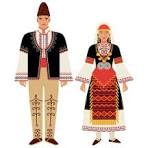
Most Bulgarians today wear modern western-style clothes, but traditional clothing remains an important source of national pride. Traditional clothes are called nosiya. Traditional dress varies significantly from one region to another. Hand-spun from natural materials like wool, hemp, linen, and cotton, these outfits functioned as living records of a person’s region, age, marital status, and social standing.
Women typically wear either a two-apron outfit consisting of front and back aprons over their chemise, or a sukman, which is a sleeveless tunic-dress layered with a brightly colored belt. Men generally dress in either belodreshnik (white woolen garments) or chernodreshnik (black woolen garments), which include fitted pants, a vest or jacket, and a wide red fabric sash wrapped around the waist. See below image of Bulgarian traditional clothing.
Cuisine
Bulgarian food reflects the country’s geography and agricultural traditions. Fresh vegetables, dairy products, grilled meats, herbs, and bread play a big part in everyday cooking.
One of the most famous dishes is Banitsa, a pastry filled with cheese and baked until golden brown. It is eaten for breakfast or during holiday celebrations. Another popular dish is Shopska Salad, made from tomatoes, cucumbers, peppers, onions, and grated white cheese. Bulgaria is also known internationally for its yogurt. Traditional Bulgarian yogurt contains a unique bacterial culture called Lactobacillus bulgaricus, which contributes to the country’s reputation of producing high-quality dairy products.
Holidays and Celebrations
Bulgaria’s holiday calendar combines religious celebrations and national commemorations. Christmas and Easter are important family holidays, especially for those who follow the Bulgarian Orthodox Church. Easter celebrations include colorful eggs, special breads, and family gatherings. Bulgaria’s most famous national holiday is Liberation Day which marks the country’s freedom from nearly 500 years of Ottoman rule. It is celebrated every year on March 3rd.
One holiday that is really interesting is the Day of Bulgarian Education and Culture and of the Slavic Script, celebrated on May 24th. The holiday honors the country’s contribution to literacy, education, and the development of the Cyrillic alphabet. Schools, universities, and cultural institutions participate in celebrations throughout the country on this day.
Business Culture
Business interactions in Bulgaria are generally professional and direct. People appreciate preparation, and clear communication. Unlike a lot of other countries where relationships are very important for good business, business discussions in Bulgaria are more focused on facts and practical details. Meetings usually begin formally, especially when people are meeting for the first time.
Titles and professional experience are respected, especially in more traditional organizations. At the same time, newer businesses and technology companies operate with a more collaborative and international style.
References
Britannica. “Bulgaria.” https://www.britannica.com/place/Bulgaria
UNESCO. “Intangible Cultural Heritage in Bulgaria.” https://ich.unesco.org
World Travel Guide. “Bulgaria History, Language and Culture.” https://www.worldtravelguide.net/guides/europe/bulgaria/history-language-culture/
Bulgaria Travel. “Bulgarian Traditions and Customs.” https://bulgariatravel.org
Wikipedia. (2026). “Culture of Bulgaria.” https://en.wikipedia.org/wiki/Culture_of_Bulgaria