This is another country that I had not heard of prior to doing this research. Cabo Verde is located in the Atlantic Ocean about 350 miles off the coast of West Africa. It is an island nation made up of ten volcanic islands. Unlike most African countries, Cabo Verde was completely uninhabited until the Portuguese arrived in the fifteenth century. As a result, the country’s culture developed from a blend of Portuguese and African influences, creating something unique. Today, Cabo Verde is known for its colorful towns, volcanic landscapes, beautiful beaches, and rich musical traditions.
One thing that stood out to me while researching Cabo Verde is how strongly the country’s identity has been shaped by the ocean. For centuries, Cabo Verde served as an important stop along Atlantic international trade routes. Its location helped connect Africa, Europe, North and South America, and those influences can still be seen throughout the country’s culture, today.
The country is well known for a musical style called morna, which combines African rhythms with Portuguese influences. Morna songs focus on longing, migration, and love. Many people compare it to Portuguese fado because of its emotional quality. The singer Cesária Évora helped introduce Cabo Verdean music to the world. Known as the “Barefoot Diva,” she performed without shoes as a tribute to the poor women of Cabo Verde.
Family Life
Family relationships remain important in Cabo Verde, but what I found especially interesting is how families often spread across multiple countries. It is common for relatives to live in different parts of the world while staying closely connected through phone communication. Because so many Cabo Verdeans have family members overseas, stories about relatives working or studying abroad are very common. This created a culture that is global and still connected to the islands.
In Cabo Verde, family life follows the concept of morabeza, a Creole word that translates to the spirit of hospitality, warmth, and an open-door policy. Because of this cultural philosophy, it is completely normal for a home to have its doors open not just to extended relatives, but also to neighbors, friends, and travelers who are always treated like family. Another interesting part of this concept is how the entire community participates in raising children. If a child is playing outside, any adult in the neighborhood can go to feed them, look after their safety, or correct their behavior. The saying “it takes a village to raise a child” is truly followed in Cabo Verde.
Language
Portuguese is the official language of Cabo Verde and is used in government, education, and official documents. However, the language spoken in everyday life is Cabo Verdean Creole, known as Kriolu. Kriolu developed through centuries of interaction between Portuguese settlers and the African people and has become one of the strongest symbols of Cabo Verdean identity. Each island has its own variation of Kriolu. While speakers can usually understand each other, accents and vocabulary can differ between islands.
Dress
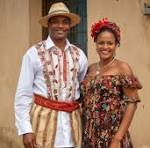
Traditional clothing is usually only worn for cultural performances, festivals, and special celebrations. Women’s traditional outfits incorporate colorful skirts and patterned fabrics, while men’s wear reflect styles historically influenced by both African and Portuguese traditions.
For women, traditional outfits include long skirts and flowing lança dresses. Brides at traditional outdoor ceremonies wear blue pánu di téra gowns symbolizing the ocean and sky. For men, traditional wear centers on a long-sleeved shirt made from African cotton and paired with tailored formal pants. See image below.
Cuisine
Seafood plays an important role in Cabo Verdean cuisine. The country’s most famous dish is cachupa, a slow-cooked stew made from corn, beans, vegetables, and either meat or fish. Many people consider it the national dish of Cabo Verde, and nearly every family has its own variation of the recipe. Because the islands experience droughts, Cabo Verdean cooking has used ingredients that are readily available despite the environmental conditions. Corn, beans, sweet potatoes, cassava, and fresh seafood are used commonly in local meals. Coffee is also grown on some islands and is a common drink that is enjoyed by everyone in Cabo Verde
Festivals and Celebrations
One of the most popular celebrations is Carnival, especially on the island of São Vicente. The festival features colorful costumes, music, dancing, and parades that include African and Portuguese traditions. Music festivals are also extremely popular and attract performers from across Africa, Europe, and the Americas. These events highlight the important role that music continues to play in Cabo Verdean society.
Business Culture
Business interactions in Cabo Verde tend to be relaxed but professional. Because of the country’s strong international connections, many Cabo Verdeans are used to working with people from different cultures and backgrounds. This is commonly seen in tourism, transportation, and international trade.
References
Britannica. “Cabo Verde.” https://www.britannica.com/place/Cape-Verde
Countries and their Cultures (Copyright 2008). “Cape Verde.” https://www.everyculture.com/Bo-Co/Cape-Verde.html
UNESCO. “Cabo Verde Cultural Heritage.” https://whc.unesco.org
Cabo Verde Tourism. “Culture and Traditions.” https://www.visitcaboverde.com
World Travel Guide. “Cape Verde History, Language and Culture.” https://www.worldtravelguide.net/guides/africa/cape-verde/history-language-culture/
Wikipedia. (2026). “Culture of Cape Verde.” https://en.wikipedia.org/wiki/Culture_of_Cape_Verde